Chemical kinetics class 12 notes Most important notes for Revision. Chemical kinetics: It is the branch of chemistry which deals with the study of reaction rates and their mechanisms.
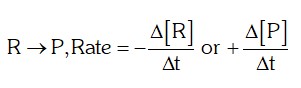
Rate of a reaction: The rate of a reaction can be defined as the change in concentration of a reactant or a product in unit time. For the reaction,
Units of rate: Concentration time–1 i.e., molL–1s–1 or atms–1 for gaseous reactions.
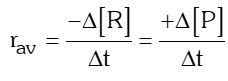
Average rate of reaction: It is the average value during large time interval.
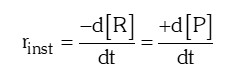
Instantaneous rate of reaction: It is the rate of a reaction at a particular instant of time i.e., when ∆t approaches zero.
Factors influencing rate of a reaction: Chemical kinetics class 12 notes
Concentration: Greater the concentrations of the reactants, faster is the rate of reaction.
Physical state of reactants: Reactions involving gaseous reactants are faster than reactions containing solid and liquid reactants.
Temperature: The rate of reaction increases with increase of temperature. For most of the reactions, rate of reaction becomes almost double with 10°C rise of temperature.
Presence of catalyst: A catalyst generally increases the speed of a reaction.
Surface are of reactants: For a reaction involving a solid reactant or catalyst, the greater is the surface are, the faster is the reaction.
Presence of light: Photochemical reactions take place in the presence of light only.
Activation energy: Lower the activation energy faster in the reaction.
Rate law and rate constant: The equation that correlates the rate of reaction with concentration of reactants is known as rate law.
For a simple reaction, A+B→C+D Rate = k[A][B] where k is the rate constant which is equal to the rate of reaction when concentration of each of the reactant is unity.
Order and molecularity:
Chemical kinetics class 12 notes table
Half-life of reaction: The time in which the concentration of a reactant is reduced to one half of its initial concentration is called half-life of the reaction.
Rate law, integrated rate law, half-life, units of rate constant and graph for the reactions of different orders: Chemical kinetics class 12 notes
Pseudo first order reactions: Those reactions which are not truly of the first order but under certain conditions become reactions of the first order are called pseudo first order reactions. e.g.
Acid hydrolysis of ethyl acetate:
Acid catalysed inversion of cane sugar:
Effect of temperature on rate of reaction:
For a chemical reaction with rise in temperature by 10° C, the rate constant is nearly doubled.
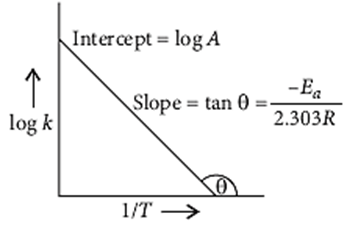
Arrhenius equation:
Chemical kinetics class 12 notes
where, k = Rate constant, A = Pre-exponential factor (frequency factor),
Ea Activation energy, T = Temperature,
Chemical kinetics class 12 notes Most important notes for Revision. Chemical kinetics: It is the branch of chemistry which deals with the study of
Activation energy: The minimum amount of energy required by reactant molecules to participate in a reaction is called activation energy (Ea).
Activation energy = Threshold energy – Average kinetic energy of reacting molecules Activation energy ( Ea ) = E(activated complex) –E(ground state) ∆H=Activation energy of forward reaction – Activation energy of backward reaction
Collision theory of chemical reactions:
Reaction occurs due to collision of molecules.
All collisions are not effective.
Effective collisions are those collisions in which molecules collide with sufficient kinetic energy (called threshold energy which is equal to activation energy + energy possessed by reacting species) and proper orientation.
Rate = PZABe–Ea/RT where, P = probability or steric factor which takes into account the fact that in a collision, molecules must be properly oriented and ZAB = collision frequency (i.e., the no. of collisions per second per unit volume of the reaction mixture) of reactants, A and B.